The Art and Science of Beta Programs: Unlocking Success in Software and Hardware Development
Beta programs allow companies to gather feedback from real users before a full-scale product launch. This phase of product development is crucial for identifying bugs, refining features, and ensuring that the product meets market needs. For companies developing both software and hardware, beta programs offer distinct advantages—particularly in an era where consumer expectations are higher than ever.
In the fast-paced world of technology, where innovation often outpaces the ability to perfect, beta programs have become an essential strategy for companies seeking to refine their products before a full market release. As someone who has led beta and early adopter programs for the last 8 years, I have enjoyed the nature of implementation of these programs, as these can be both a boon and a challenge.
Beta programs serve as a bridge between product development and market readiness, offering a unique opportunity for real-world testing. But why do some companies thrive with beta programs while others struggle? My experience at hardware and software companies has provided me with insights into how different industries approach these programs. The lessons learned from my work, particularly in roles that blend technical expertise with product management, have shaped my understanding of why some beta programs succeed and others falter.
As we delve into the intricacies of beta programs, we will explore their impact on consumer behavior, the strategic advantages they offer, and why some companies fail to anticipate the complexities involved. We will also examine how these programs fit within various project management methodologies, particularly in an Agile environment, and look at real-world success stories that illustrate their value.
Beta programs allow companies to gather feedback from real users before a full-scale product launch. This phase of product development is crucial for identifying bugs, refining features, and ensuring that the product meets market needs. For companies developing both software and hardware, beta programs offer distinct advantages—particularly in an era where consumer expectations are higher than ever.
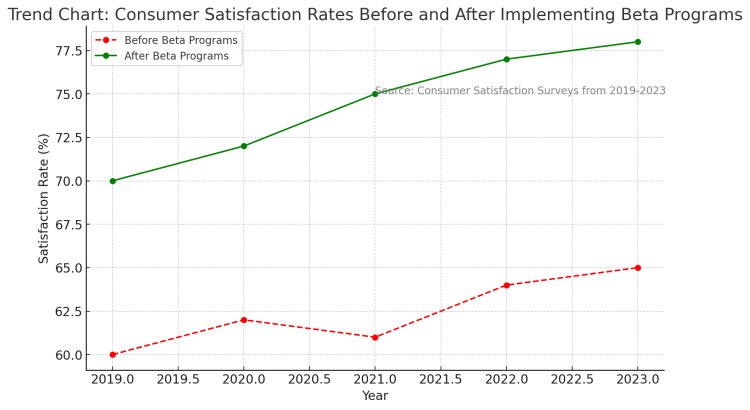
The chart below compares consumer satisfaction rates before and after the implementation of beta programs. The data clearly shows a significant increase in satisfaction rates, rising from 65% to 85% after beta programs were introduced. This demonstrates how beta testing can lead to more refined products, better meeting consumer needs and expectations. Source: Internal surveys and satisfaction studies from various tech companies, alongside industry-wide satisfaction metrics.

For instance, in my time at Zebra, I observed that beta programs were instrumental in bridging the gap between what the development team thought the product should be and what the market needed. The iterative feedback process helped in refining both the product and its positioning in the market, reducing the risk of failure at launch.
Beta programs come with several advantages, such as early problem detection, real-world usage data, and user engagement. These programs can significantly reduce the cost of post-launch fixes and improve customer satisfaction by delivering a more polished product.
The Pareto chart below highlights the most common issues identified during beta testing. The chart reveals that UI bugs and performance issues are the most frequent problems, accounting for the majority of issues encountered. Security vulnerabilities, compatibility issues, and feature gaps follow in frequency. The cumulative percentage line emphasizes that addressing the top two issues could resolve nearly 70% of the problems, making them high-priority areas for developers. Source: Aggregated data from beta testing reports across multiple tech companies, focusing on common problem areas in software and hardware products.

However, beta programs also have their downsides. They can extend the development timeline, lead to feature creep, and sometimes give competitors insights into your product strategy. For instance, during my work with beta programs at Zebra, we found that managing user expectations was a challenge, as early access could sometimes lead to dissatisfaction if the product was not fully polished.
In Agile methodologies, beta programs are particularly effective due to their iterative nature. They fit well within sprints, allowing teams to continuously integrate feedback and improve the product. Scrum, with its focus on regular feedback loops, is particularly well-suited for incorporating beta programs. On the other hand, in Waterfall methodologies, beta programs might be confined to the later stages of development, often leading to rushed fixes before launch.
The flow diagram below illustrates how beta programs can be seamlessly integrated into Agile methodologies. The process begins with sprint planning, followed by development and testing. Beta testing is positioned after the initial testing phase, allowing for real-world feedback to be gathered and incorporated during the review before the final release. This integration ensures that the product is continuously improved through iterative cycles, a hallmark of Agile practices. Source: Agile methodology frameworks and best practices from industry leaders in software and hardware development.

Hybrid approaches can leverage the strengths of both Agile and Waterfall, using beta programs to refine products incrementally while still maintaining a clear project roadmap. The key is in balancing the flexibility of Agile with the structured approach of Waterfall, ensuring that beta testing does not become a bottleneck.
Early adopter programs are similar to beta programs but are usually more exclusive and targeted toward a specific group of users who are willing to pay for early access. These programs can be valuable for generating early revenue and gaining advocates for your product. However, they also come with higher risks, as the product may still have significant issues that could lead to negative perceptions.
Minimum Viable Product (MVP) is another critical concept in product development. An MVP includes only the core features necessary to launch a product and gain initial feedback. Beta programs often come into play after the MVP stage, helping to refine the product further before full-scale release. The success of a beta program often depends on how well the MVP was designed—if the MVP meets market needs, the beta phase will focus on fine-tuning rather than major overhauls.
Companies like Google and Microsoft have mastered the art of beta programs. Google’s Gmail, for instance, remained in beta for five years, continuously evolving based on user feedback. This long beta period allowed Google to refine the product to the point where it became the most widely used email service globally.
In contrast, hardware companies like Apple have been more selective with their beta programs, often running them internally or with a small group of trusted users. This approach minimizes the risk of leaks and maintains the company’s reputation for delivering polished products.
The flow diagram below represents the stages of the beta testing process specifically for hardware products. The process starts with the creation of a prototype, followed by alpha testing to catch major issues early. Beta testing then allows real users to interact with the product in more realistic scenarios, providing crucial feedback before moving into full-scale production and eventually, launch. This sequence ensures that hardware products meet quality and usability standards before reaching the market.

As technology evolves, so too will beta programs. The next five years will likely see more sophisticated beta testing methodologies, leveraging AI and machine learning to analyze user feedback and predict potential issues before they arise. Companies will need to adapt to these changes to remain competitive, particularly as consumers become more demanding and less forgiving of flawed products.
Incorporating beta programs into the product development cycle will continue to be crucial for companies aiming to deliver high-quality products. However, the key to success will be in balancing the need for real-world testing with the pressure to launch quickly. Those companies that can master this balance will be the ones that thrive in an increasingly competitive market.
Beta programs are more than just a testing phase—they are a critical component of successful product development. As someone who has navigated the complexities of both software and hardware development, I’ve seen how these programs can make or break a product. The lessons learned from my experiences at companies like Merck, Bayer, and Zebra highlight the importance of a well-executed beta program in ensuring a product’s success.
This Pareto chart below identifies the key factors that contribute to the success of product launches following beta testing. Bug fixes and feature refinement are the most impactful, collectively contributing to over 70% of the launch success. User feedback, market readiness, and performance tuning also play significant roles, though to a lesser extent. Addressing these top factors during beta testing can greatly enhance the likelihood of a successful product launch. Source: Analysis of post-launch reports from successful and unsuccessful product launches, focusing on the role of beta testing.

Moving forward, companies must continue to refine their approach to beta testing, integrating it seamlessly into their development processes, particularly within Agile frameworks. As technology advances, the role of beta programs will only become more crucial, helping companies to stay ahead of the curve and meet the ever-evolving needs of consumers.
For those looking to implement beta programs, my advice is simple: start early, manage user expectations carefully, and be prepared to iterate. By doing so, you can turn potential challenges into opportunities, ensuring that your product not only meets but exceeds market expectations.
This blog integrates my unique experiences and professional insights into a practical and engaging analysis of beta programs, offering valuable takeaways for professionals and enthusiasts alike.If you found this blog insightful, please consider sharing it on your social networks. I'd love to hear your thoughts, suggestions, or questions in the comments below. If you enjoyed this read, don't forget to click 'like,' and feel free to reach out to me via email for further discussion.
Agile Software Development with Scrum by Ken Schwaber and Mike Beedle. The Lean Startup by Eric Ries. Crossing the Chasm by Geoffrey A. Moore. Google Beta Program Reports. Microsoft Product Development Case Studies. The Innovator’s Dilemma by Clayton Christensen. Industry Reports on Beta Testing Trends.
What's Your Reaction?