Designing the Domain Backbone of XmartPro.ai
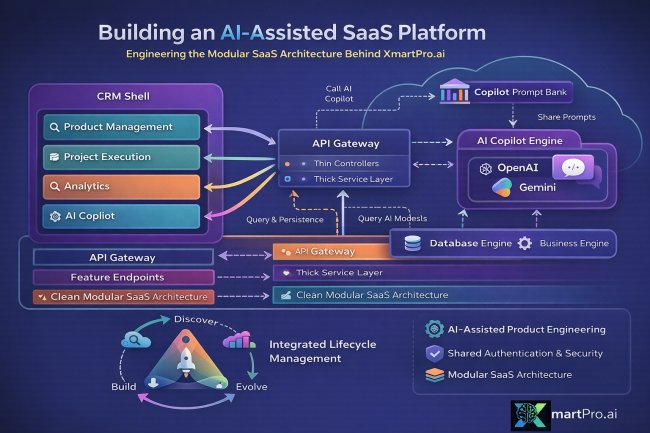
Explore how XmartPro.ai was engineered using domain-driven design, modular SaaS architecture, multi-tenant routing, AI copilots, and integrated DevOps analytics to accelerate modern product engineering.
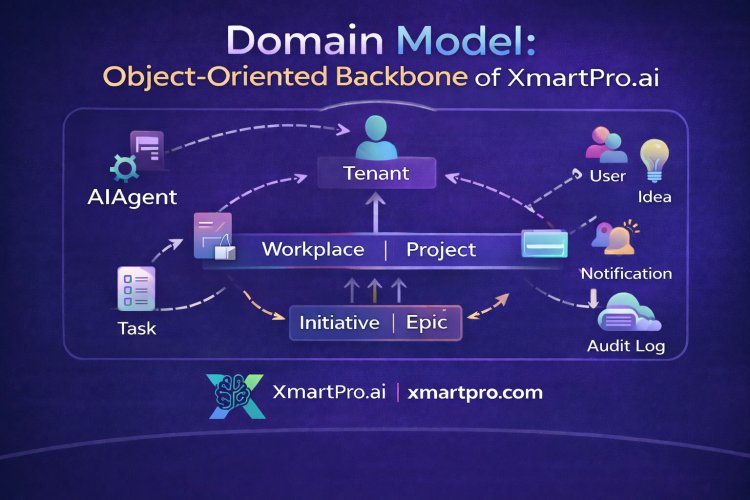
Domain-Driven Architecture for Product Engineering Platforms
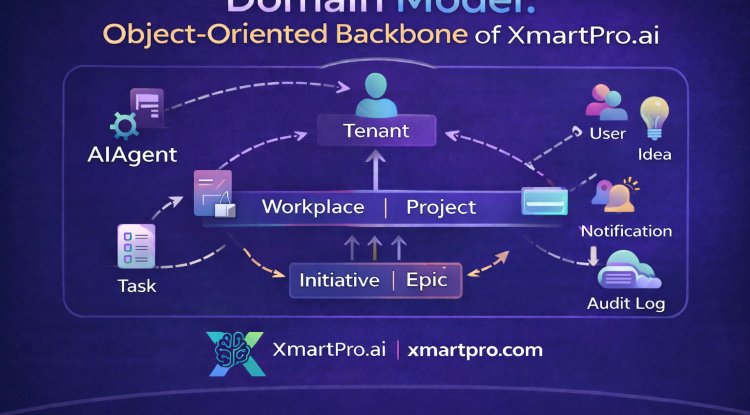
One of the most important architectural decisions behind XmartPro.ai was to design the system around a domain-driven model rather than a feature-driven architecture. In many SaaS products, features evolve independently over time and eventually create inconsistencies across the platform. The same concept might be represented differently in analytics dashboards, project management modules, or customer workflows. These inconsistencies lead to what I refer to as object drift, where the same concept is represented multiple ways across the system. Preventing this drift was one of the main goals of the domain model used in XmartPro.ai.
The domain model defines the core objects that represent how real product organizations operate. Instead of building isolated features first, we began by identifying the key entities that define a modern product development organization. These objects include Tenant, User, Workplace, Project, Initiative, Epic, Story, Task, Idea, AIAgent, Notification, and AuditLog. Each of these entities has a clear responsibility within the lifecycle of product development. By modeling the system around these objects, every UI workflow, API endpoint, and service layer operation maps back to a consistent conceptual model.
From a user perspective, this domain-driven design creates a coherent experience across the platform. Product managers, engineers, and stakeholders interact with objects that behave consistently regardless of the module they are working in. A Project behaves the same way in analytics dashboards as it does in roadmap planning or sprint execution boards. An Epic maintains its identity whether it appears inside project execution workflows or inside product planning analytics. This consistency reduces cognitive overhead for users and ensures that the platform reflects how real product organizations think about their work.
Internally, the domain model acts as the backbone for the entire system architecture. Controllers, service classes, and database models are structured around these domain objects. Instead of writing logic that directly manipulates database tables or UI states, services operate on domain entities. This approach ensures that business rules remain centralized and consistent. When a new feature is added to the platform, it interacts with the same domain model rather than creating parallel representations of the same concepts.
Another important advantage of this approach is that it simplifies the integration of AI-assisted workflows. Because the AI Copilot engine interacts with structured domain objects such as stories, or initiatives, it can generate meaningful insights rather than generic responses. For example, when a user asks the Copilot to generate a PRD summary, the AI service can reference structured objects like Idea, and Project metadata stored within the domain model. This structured context significantly improves the relevance and usefulness of AI-generated responses.
Competitor platforms often struggle with this level of consistency because they are designed as feature collections rather than domain-driven systems. A typical toolchain might include separate products for roadmap planning, sprint execution, and analytics dashboards. Each product maintains its own internal representation of objects such as tasks or projects. Integrating these systems often requires complex synchronization mechanisms. In contrast, XmartPro.ai uses a single domain backbone, ensuring that every module operates on the same conceptual model.
The domain-driven architecture also enables the platform to evolve more easily as new capabilities are introduced. When new features are added—such as AI-driven analytics or automated project planning—they can extend existing domain objects rather than creating entirely new models. This extensibility ensures that the system remains maintainable as it grows in complexity. Engineers can add new services, controllers, or APIs while relying on the same foundational object model that defines the platform.
Tenant-Aware SaaS Routing

Another critical component of the XmartPro.ai architecture is tenant-aware routing, which allows the platform to function as a true multi-tenant SaaS system. In a multi-tenant environment, multiple organizations use the same application infrastructure while maintaining complete separation of data and configuration. Each organization operates within its own tenant context, which determines everything from database access to user interface customization.
The platform achieves this through a tenant resolver filter that executes before each request is processed. The resolver identifies which tenant the request belongs to by analyzing the incoming domain or request headers. If the request originates from a subdomain such as tenantname.xmartpro.ai, the resolver extracts the subdomain and maps it to a corresponding tenant record stored in the platform’s database. Once the tenant is identified, the system loads configuration parameters such as theme settings, landing pages, and access permissions into the user session.
This resolver ensures that every request entering the platform is associated with the correct tenant. Once the tenant context is established, the application loads the tenant’s configuration into the session. This includes user interface themes, default landing pages, and tenant-specific settings. By storing these values in the session, the platform avoids repeated database lookups and improves overall performance.
However, identifying a tenant is only part of the solution. The platform must also enforce tenant isolation to ensure that users cannot accidentally access resources belonging to another organization. This responsibility is handled by a second filter called TenantEnforce, which verifies that the active session matches the tenant subdomain being accessed. If a mismatch is detected, the user is automatically redirected to the correct tenant environment.
This enforcement layer ensures that users remain inside the correct tenant environment even if they attempt to access the platform through an incorrect subdomain. If the system detects that the session tenant differs from the requested domain, it redirects the user to the appropriate tenant-specific entry point. This mechanism guarantees strong tenant isolation while preserving a seamless user experience.
The result is a platform that behaves like a true SaaS product. Each organization accesses the system through its own subdomain, experiences its own customized interface, and interacts with data stored within its tenant context. At the same time, the underlying infrastructure remains shared and efficient. This architecture allows XmartPro.ai to scale across many organizations while maintaining strict separation between tenants.
Designing Security as a First-Class Architectural Layer

Security is not something that can be added to a SaaS platform after the architecture is complete. Instead, it must be treated as a first-class architectural concern from the very beginning of system design. When building XmartPro.ai, the goal was to create a platform that could safely support multiple organizations operating within a shared infrastructure while ensuring strict separation of data, workflows, and permissions. Achieving this required implementing a layered security model that integrates authentication, authorization, request validation, and audit logging directly into the platform’s lifecycle architecture.
One of the first decisions made during development was to implement shared authentication guards across all platform modules. Because XmartPro.ai integrates multiple domains—product management, project execution, analytics, AI Copilot services, and CRM workflows—security policies must be enforced consistently across every endpoint. Rather than allowing each module to implement its own authentication logic, the platform centralizes access control through reusable guards and filters that operate before requests reach application controllers. This approach ensures that security policies remain consistent throughout the system.
Authentication within XmartPro.ai is handled through a session-based security model supported by CodeIgniter’s authentication mechanisms. Once a user logs into the platform, a secure session is established containing identity attributes such as user ID, tenant context, and role permissions. This session information becomes the foundation for authorization decisions across the platform. Controllers and services can verify user identity and privileges without repeatedly querying authentication services, improving both security and performance.
The platform also implements Cross-Site Request Forgery (CSRF) protection across all API endpoints and form submissions. CSRF attacks attempt to trick authenticated users into executing unintended actions on a web application. By enforcing CSRF tokens on sensitive operations such as API requests, configuration changes, or data updates, XmartPro.ai ensures that only authorized requests originating from the platform interface are accepted. This protection is automatically applied through the framework’s security filters and verified before requests reach the service layer.
Role-Based Access Control
Another critical aspect of the platform’s security architecture is role-based access control (RBAC). In a multi-tenant SaaS platform, different users must have different levels of access depending on their roles within an organization. Product managers, engineers, administrators, and external stakeholders all interact with the system in different ways. RBAC ensures that each user can only access features and data appropriate to their role while preventing unauthorized operations.
In XmartPro.ai, user permissions are mapped to roles stored within the domain model. Each role is associated with a set of capabilities that determine which modules and operations are accessible. For example, a product manager may have permission to create product roadmaps and manage epics, while an engineer may only have access to development boards and sprint tasks. Administrators may have broader privileges, including tenant configuration and user management.
This authorization logic is enforced through middleware filters that intercept incoming requests before they reach controllers. When a request is received, the platform checks the user’s session context to verify both authentication and role permissions. If the user lacks the required privileges, the request is rejected before any business logic is executed. This early validation ensures that unauthorized actions are blocked efficiently and consistently.
The RBAC system also integrates with the platform’s domain model. Because core entities such as Project, Epic, Story, and Task are first-class objects within the system, permission checks can be applied at the object level. This allows the platform to enforce fine-grained access control policies such as restricting editing privileges for certain projects or limiting visibility of sensitive product roadmaps.
Audit Logging and Governance
In enterprise SaaS environments, it is not enough to prevent unauthorized actions; organizations must also maintain detailed records of system activity. This requirement led to the implementation of comprehensive audit logging within XmartPro.ai. Every significant action performed within the platform—such as modifying project data, generating AI responses, or updating configuration settings—is recorded in the audit log system.
The AuditLog domain object plays a key role in this governance model. Each log entry records metadata such as the user performing the action, the affected object, the operation type, and the timestamp of the event. This information allows administrators to track changes across the platform and identify potential security or compliance issues. Audit logs also support operational analytics by providing insights into how users interact with different platform features.
Audit logging becomes particularly important when AI capabilities are integrated into a platform. Because AI Copilot services may generate content or recommendations that influence decision-making, the system must record how and when these interactions occur. XmartPro.ai logs AI prompt requests, responses, and contextual metadata to ensure that organizations can review and understand how AI-assisted workflows impact product development processes.
These governance mechanisms ensure that the platform remains transparent and accountable even as it integrates advanced automation capabilities. Administrators can review system activity, analyze usage patterns, and enforce compliance policies without disrupting normal workflows.
Secure AI Integration
Integrating artificial intelligence into a SaaS platform introduces additional security considerations. AI systems interact with user data, generate content, and sometimes access sensitive organizational information. To address these challenges, XmartPro.ai implements a controlled integration layer between the application and external AI providers such as OpenAI or Gemini.
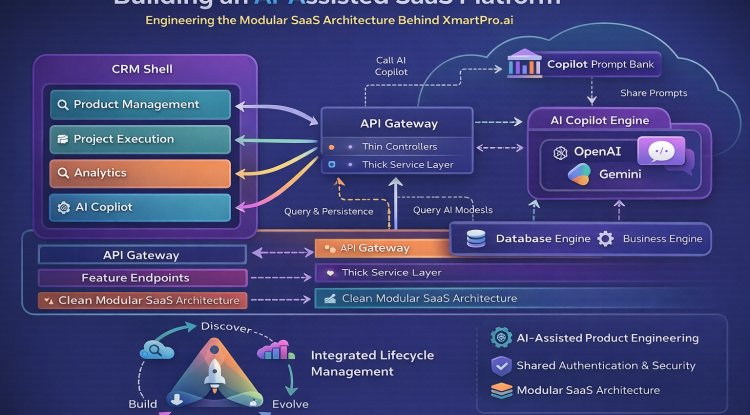
All AI requests are routed through the Copilot service layer, which acts as a security gateway between application modules and external AI APIs. This gateway validates prompts, filters sensitive data, and records interaction metadata before sending requests to external AI engines. By centralizing AI communication through this service layer, the platform ensures that AI interactions remain auditable and compliant with organizational policies.
The Copilot architecture also allows administrators to control how AI is used across the platform. Organizations can configure prompt templates, restrict AI features for specific roles, or limit access to certain AI capabilities. These governance controls ensure that AI remains a productive tool without introducing unintended security risks.
Building Trust Through Secure Architecture
Ultimately, the goal of the security architecture in XmartPro.ai is to create a platform that organizations can trust with their most critical product development processes. Security mechanisms such as authentication guards, tenant isolation, role-based access control, and audit logging work together to create a layered defense strategy. Each layer protects a different aspect of the system while maintaining a seamless user experience.
By integrating security directly into the platform architecture rather than treating it as an afterthought, XmartPro.ai provides a strong foundation for organizations operating in multi-tenant SaaS environments. Product teams can collaborate, engineers can deploy software, and AI copilots can assist development workflows—all within a secure and governed infrastructure.
This approach ensures that the platform not only accelerates innovation but also maintains the
Observability, Analytics, and Product Intelligence in XmartPro.ai

Turning Product Data into Actionable Intelligence
Modern SaaS platforms generate enormous amounts of operational data. Every user interaction, feature release, deployment event, and support request produces signals about how the product behaves in real-world environments. However, collecting data alone is not enough. Organizations must transform this data into actionable intelligence that informs product strategy and engineering decisions. XmartPro.ai was designed with this philosophy in mind: observability and analytics should be embedded directly into the product lifecycle rather than treated as external reporting tools.
Observability within the platform focuses on capturing signals across the entire development and operational lifecycle. Product managers can monitor feature adoption, engineering teams can track deployment metrics, and support teams can analyze operational incidents. Instead of viewing these signals in isolation, the platform correlates them through a unified analytics layer. This integration allows organizations to understand how engineering activities affect product outcomes and how operational events influence product strategy.
The analytics system in XmartPro.ai operates as a shared platform capability rather than a standalone reporting module. Data from product management workflows, project execution activities, DevOps monitoring systems, and support interactions is aggregated into a centralized analytics service. This architecture enables the platform to generate dashboards and insights that reflect the full lifecycle of product development. Product leaders gain visibility into how features perform in production, while engineering teams can analyze system performance trends alongside development progress.
This lifecycle-driven analytics approach is particularly important in AI-assisted development environments. Because the platform integrates AI Copilot services across multiple workflows, analytics must also track how AI interactions influence product development outcomes. Metrics such as prompt usage frequency, AI response accuracy, and AI-assisted task completion rates provide valuable insights into how effectively AI tools are supporting engineering teams.
Analytics Architecture
The analytics architecture of XmartPro.ai is built around a modular service layer that collects and processes data from multiple domains of the platform. Each module—product management, project execution, DevOps monitoring, and SSE support—generates structured events that are captured by the analytics engine. These events are stored in a centralized data store designed for efficient querying and aggregation. The analytics service then exposes APIs that allow dashboards and reporting tools to retrieve insights in real time.
This architecture ensures that analytics capabilities remain scalable as the platform grows. Instead of embedding reporting logic inside individual modules, each module simply emits events describing significant actions such as feature creation, task completion, deployment events, or incident reports. The analytics service consumes these events and constructs aggregated views of system activity. This event-driven design allows the platform to evolve without rewriting analytics logic whenever new features are introduced.
Dashboards within XmartPro.ai are built on top of these analytics APIs. Product leaders can view strategic dashboards showing product roadmap progress, engineering velocity, and feature adoption metrics. Engineering teams can access operational dashboards displaying deployment frequency, incident resolution times, and performance indicators. Because these dashboards draw data from the same analytics infrastructure, they present a consistent view of the platform’s performance across different roles.
Another important capability of the analytics architecture is its ability to integrate AI-driven insights. The Copilot engine can analyze analytics datasets to identify patterns that may not be immediately visible to human observers. For example, the AI system may detect correlations between specific feature releases and changes in user engagement or identify recurring operational issues related to components of the system. These insights help product teams prioritize improvements and optimize development strategies.
Product Intelligence
Product intelligence extends beyond simple analytics by combining operational data with contextual knowledge about product features and development workflows. In XmartPro.ai, product intelligence emerges from the integration of analytics data with the domain model used throughout the platform. Because entities such as Projects, Epics, Stories, and Tasks are first-class objects in the system, analytics events can be directly associated with these objects. This connection allows the platform to analyze how specific product features influence operational outcomes.
For example, if a newly released feature results in increased support incidents, the analytics system can trace those incidents back to the specific Epic or Story responsible for the feature. Product managers can immediately identify which part of the roadmap requires improvement. Conversely, if a feature significantly increases user engagement, the platform can highlight that success and encourage further investment in similar capabilities. This level of insight transforms analytics into a strategic decision-making tool.
Product intelligence also supports cross-functional collaboration within organizations. Because analytics data is linked to domain objects, different teams can interpret the same information in ways relevant to their responsibilities. Product managers may focus on adoption trends and roadmap alignment, while engineers examine performance metrics and system reliability. Support teams can analyze incident patterns and customer feedback. By providing a unified view of product data, XmartPro.ai enables teams to collaborate more effectively around shared insights.
The integration of AI Copilot services enhances this product intelligence layer even further. Instead of manually analyzing dashboards, users can ask the AI Copilot questions about system behavior. For instance, a product manager might ask the Copilot to summarize the performance impact of recent releases or identify which features generated the most support requests. The Copilot analyzes the analytics dataset and generates contextual explanations that help teams interpret complex data quickly.
Observability for AI-Driven Development
Observability becomes even more critical when AI systems are integrated into product workflows. Because AI-generated insights influence decision-making, organizations must be able to monitor how AI interactions occur within the platform. XmartPro.ai includes observability mechanisms that track AI usage patterns, prompt interactions, and response outcomes. These metrics help administrators evaluate how effectively AI copilots are assisting development teams.
The platform records metadata for every AI interaction, including the module where the request originated, the prompt template used, the response generated, and the time required to process the request. This information allows the analytics engine to produce reports on AI usage trends across the organization. Product leaders can evaluate whether AI tools are improving productivity, while engineers can identify opportunities to refine prompt templates and enhance AI performance.
Observability also ensures transparency and accountability in AI-assisted workflows. Because AI recommendations may influence product decisions, organizations must be able to review how those recommendations were generated. By logging prompts and responses within the analytics system, XmartPro.ai creates a traceable record of AI interactions. This capability supports governance requirements and enables teams to audit AI-assisted decisions when necessary.
Ultimately, observability, analytics, and product intelligence form the data backbone of the XmartPro.ai platform. By capturing signals across the entire lifecycle and integrating them with AI-assisted analysis, the platform transforms raw operational data into meaningful insights that guide product innovation. Teams gain the ability to monitor system performance, evaluate development progress, and continuously refine their strategies based on real-world evidence.
Scaling the XmartPro.ai Platform
Infrastructure, Performance, and Future AI Automation
Designing a modern SaaS platform requires thinking beyond initial functionality and planning for scalability from the very beginning. XmartPro.ai was designed with this principle in mind. Because the platform integrates product management, project execution, DevOps monitoring, analytics, and AI-assisted workflows, it must support growing organizations without sacrificing performance or reliability. Achieving this balance required designing an architecture capable of scaling horizontally while maintaining modular boundaries between platform components.
One of the key decisions made during the development of XmartPro.ai was to maintain a lightweight backend architecture capable of running efficiently in shared hosting environments while remaining flexible enough to scale to cloud infrastructure. Using CodeIgniter 4 with PHP 8.2 allows the platform to deliver strong performance with minimal overhead. The modular service-layer architecture ensures that new capabilities can be added without introducing unnecessary complexity into the core system.
Scalability in a multi-tenant SaaS platform also depends heavily on how data is organized and isolated between organizations. XmartPro.ai uses a tenant-aware architecture where each request is associated with a specific tenant context. This context determines which data the user can access and how the platform behaves within that organization’s environment. Because tenant resolution occurs early in the request lifecycle, the platform can efficiently route requests to the correct data structures without introducing additional overhead.
Performance optimization also relies on efficient data access patterns. The platform’s domain-driven architecture ensures that queries operate on structured entities such as Projects, Epics, Stories, and Tasks rather than generic data tables. This approach allows the system to optimize database access patterns and maintain consistent relationships between objects. Combined with caching strategies and optimized service-layer operations, the platform can handle increasing workloads while preserving responsiveness for users.
Another important component of the scalability strategy is event-driven architecture for analytics and observability. Instead of performing heavy analytics queries directly within operational workflows, XmartPro.ai captures structured events representing significant system activities. These events are processed asynchronously by the analytics engine, allowing dashboards and insights to be generated without slowing down transactional operations. This separation between operational processing and analytical computation enables the platform to scale analytics capabilities independently from the core application.
As AI capabilities continue to expand within the platform, scalability considerations extend to the integration of external AI services. The Copilot service layer acts as a gateway between platform modules and AI providers such as OpenAI or Gemini. By centralizing AI communication through this service layer, the platform can control request rates, manage API usage, and implement caching mechanisms for repeated queries. This architecture ensures that AI interactions remain efficient and cost-effective even as usage grows.
Looking ahead, the platform architecture also supports future automation pipelines driven by artificial intelligence. These pipelines could automatically analyze product data, generate strategic insights, and recommend improvements to development workflows. For example, AI systems could analyze engineering velocity metrics and suggest adjustments to sprint planning, or detect patterns in incident reports that indicate architectural weaknesses. By integrating AI-driven automation into the lifecycle architecture, XmartPro.ai moves toward a future where product development environments become increasingly intelligent and self-optimizing.
Lessons Learned
Building XmartPro.ai has been one of the most intellectually rewarding engineering projects of my career. The platform emerged from more than two decades of experience across electrical engineering, software development, product management, and large-scale project leadership. One of the most important lessons learned during this journey is that innovation requires both experimentation and discipline. Artificial intelligence can accelerate development dramatically, but without strong architectural foundations it quickly becomes difficult to manage.
Another critical lesson involves the importance of domain-driven architecture. Designing the system around real-world entities such as Projects, Epics, Stories, and Product Initiatives ensured that every part of the platform remained aligned with how product organizations work. This approach prevented inconsistencies between modules and allowed new features to integrate naturally into the existing architecture.
Working with generative AI tools also highlighted the value of treating AI as a collaborative engineering assistant rather than an autonomous system. Engineers remain responsible for defining architecture, validating system behavior, and ensuring reliability. AI excels at generating code fragments, analyzing data, and exploring alternative design approaches. When combined with strong engineering practices, this collaboration can dramatically accelerate innovation.
Finally, the development process reinforced the importance of continuous feedback loops in modern software platforms. Observability, analytics, and operational insights must feed directly into product decision-making processes. XmartPro.ai integrates these feedback loops into the core architecture, ensuring that development teams learn continuously from real-world usage data.
Conclusion
The evolution of artificial intelligence is reshaping how software systems are designed, built, and operated. Generative AI tools are transforming development workflows, enabling engineers to prototype solutions faster and explore new architectural possibilities. At the same time, organizations are searching for ways to integrate product strategy, engineering execution, and operational intelligence into cohesive platforms that support rapid innovation.
XmartPro.ai represents an attempt to address these challenges by combining AI-assisted development with an integrated lifecycle architecture. By connecting product discovery, project execution, DevOps monitoring, analytics, and AI copilots into a unified environment, the platform enables teams to move from idea to operational software faster than traditional development models allow.
The architecture demonstrates how artificial intelligence can become an integral part of product engineering environments rather than an external tool. Through structured domain models, modular service layers, and centralized AI Copilot services, the platform allows organizations to harness AI capabilities without compromising architectural discipline or system reliability.
Ultimately, the goal of XmartPro.ai is not only to provide a set of tools but to enable a new approach to software development—one where product teams, engineers, and intelligent systems collaborate within a unified platform to build innovative solutions more efficiently.
Next Improvements and Future Directions
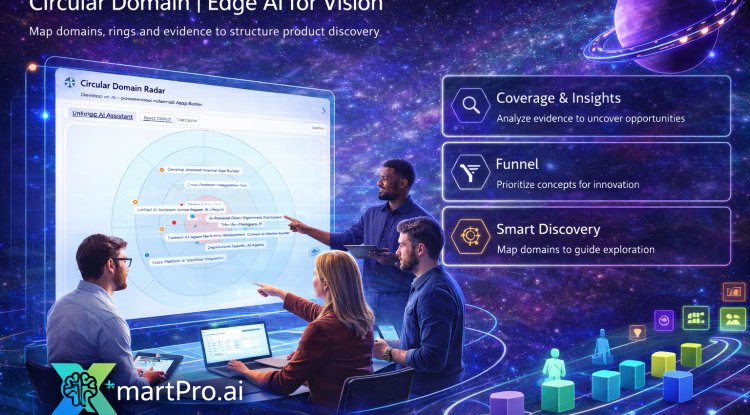
While the current implementation of XmartPro.ai already integrates AI-assisted development across multiple domains, several opportunities exist to expand the platform’s capabilities even further. One promising direction involves deeper automation of product discovery processes. AI systems could analyze market data, competitor landscapes, and user feedback to generate opportunity insights automatically, helping product teams identify innovation areas.
Another area of improvement involves expanding the capabilities of the AI Copilot engine. Future versions of the platform could enable Copilot agents to participate more actively in development workflows. For example, AI agents could analyze sprint progress, detect bottlenecks in development pipelines, or recommend architectural improvements based on operational metrics. This would transform the Copilot from a reactive assistant into a proactive engineering advisor.
Automation can also extend to DevOps intelligence. By analyzing deployment metrics, system logs, and performance indicators, AI systems could predict potential failures before they occur. Integrating predictive analytics into the SSE lifecycle modules would enable organizations to transition from reactive monitoring to proactive reliability engineering.
Finally, the platform could evolve into a broader ecosystem by supporting ISV extensions and third-party integrations. Developers could build specialized modules for industry-specific workflows, advanced analytics, or custom AI models. This ecosystem approach would allow organizations to tailor the platform to their unique needs while preserving the core lifecycle architecture.
Final Thoughts
Developing XmartPro.ai has been an exciting journey of experimentation, engineering exploration, and product innovation. The project represents the convergence of many disciplines that have shaped my career: engineering rigor, product thinking, project leadership, and emerging artificial intelligence technologies.
As the software industry continues to evolve, platforms that combine AI-assisted development with integrated lifecycle management will become increasingly important. XmartPro.ai represents my contribution to this evolution—a platform designed to help teams transform ideas into impactful solutions faster while maintaining the engineering discipline required for reliable enterprise software.
If you would like to learn more, I invite you to visit https://xmartpro.com, our corporate website where you can contact our sales team, explore ISV partnership opportunities, and learn more about investor initiatives within the XmartPro ecosystem. You can also experience the platform directly at https://xmartpro.ai, where you can explore the SaaS solution and request a demonstration.
If you found this article valuable, please feel free to leave a comment, share your perspective, and rate the blog. Your feedback helps shape future discussions and contributes to building a stronger community around AI-driven product engineering and innovation.
What's Your Reaction?