


Building XmartPro.ai: Modular SaaS Architecture that Scales with AI
 Manuel Caicedo
Discover how XmartPro.ai was engineered using modular SaaS architecture, AI copilots, and integrated DevOps workflows. Learn how AI-assisted product engineering accelerates software development from idea to deployment.
Building XmartPro.ai: Modular SaaS Architecture that Scales with AI
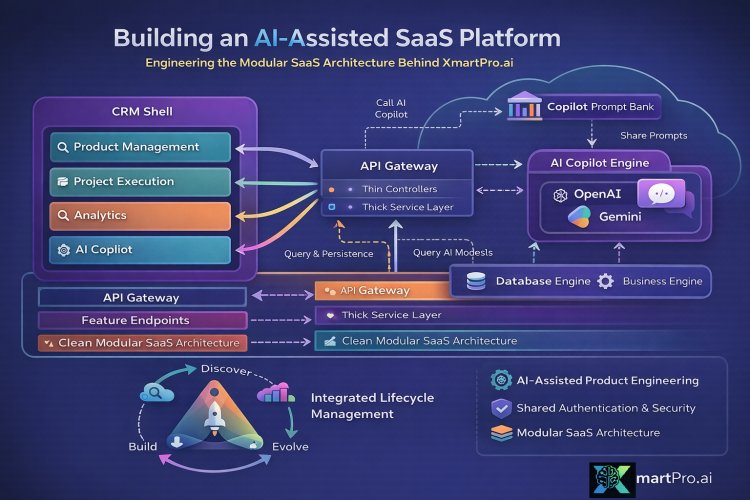
One of the most important design decisions behind XmartPro.ai was the decision to build the platform around a modular SaaS architecture rather than a monolithic application. The goal was simple but ambitious: the system should feel like one coherent platform even though it contains multiple domains such as CRM, Product Management, Project Execution, Analytics, and AI Copilot services. From the user perspective, everything moves together seamlessly. From the engineering perspective, however, each capability operates as an independent module that can evolve without disrupting the rest of the system.
To achieve this balance between integration and modularity, I selected CodeIgniter 4.x running on PHP 8.2 as the foundation of the backend architecture. CI4 provides a lightweight framework that performs extremely well on shared hosting environments while still offering the architectural flexibility required for modular systems. On the frontend side, the platform uses Bootstrap 5 combined with HTMX and Alpine.js, allowing dynamic user interactions without introducing the complexity of large frontend frameworks. This stack keeps the application responsive, maintainable, and scalable while preserving the simplicity required for rapid SaaS development.
The guiding principle for the backend architecture became what I call “thin controllers and thick services.” In this model, controllers act primarily as entry points responsible for validating input parameters, verifying user permissions, and delegating work to specialized service classes. The service layer contains the real business logic of the system. Meanwhile, models remain focused solely on data persistence and database interactions. This separation of concerns ensures that the codebase remains organized and testable as the platform grows in complexity.
This architecture is clearly reflected in the internal API flow of the platform, where requests move through a structured pipeline: the frontend interface communicates with an API gateway, which routes requests to controllers responsible for validating security policies. Controllers then call service classes that execute business logic before interacting with databases or AI engines. The result is a predictable and maintainable architecture where responsibilities are clearly defined. This approach also allows the platform to integrate AI services seamlessly without tightly coupling them to core application logic.
One of the major benefits of this modular architecture is that individual product surfaces can evolve independently. In XmartPro.ai, modules such as Idea Intake, Product Roadmaps, Kanban Project Boards, Synchronization Services, AI Copilot, and the CRM shell are implemented as independent components that share common authentication and session infrastructure. Because each module communicates through clearly defined services and endpoints, engineers can extend or refactor individual capabilities without risking unintended side effects across the system.
Many traditional software ecosystems struggle with this level of integration because they rely on toolchains composed of independent products. A typical organization may combine Jira for project management, a separate roadmap platform for product planning, a CRM system for customer management, and an IT service management tool for operational support. Each tool maintains its own data model and workflow logic. Integrating these systems often requires complex middleware and synchronization processes, creating multiple “sources of truth” within the organization.
XmartPro.ai takes a fundamentally different approach. Instead of integrating external tools, the platform is designed as a set of products living inside one codebase. Analytics, Product Management, Project Execution, SSE lifecycle management, CRM, and AI Copilot services are all independent domains within the same architecture. Each domain exposes its own endpoints while sharing authentication policies, security guards, and session context. This architecture provides the flexibility of independent systems while maintaining the coherence of a unified platform.
At the routing level, this design is implemented through CodeIgniter route groups, which organize endpoints according to domain responsibilities. Each group can apply its own middleware filters for authentication, authorization, and security policies. For example, analytics and AI Copilot endpoints are grouped under a dedicated route namespace protected by an authentication guard. This structure ensures that access control policies are enforced consistently across modules while keeping routing logic clean and maintainable.
Below is an example of how the platform organizes analytics and copilot functionality through CI4 route groups:
// Copilot & Widgets endpoints
$routes->group('analytics', ['namespace' => 'App\Controllers', 'filter' => 'authguard'], static function($routes){
    $routes->post('copilot/ask', 'Analytics::copilotAsk');
    $routes->post('copilot/addWidget', 'Analytics::copilotAddWidget');
    $routes->get('copilot/logs', 'Analytics::copilotLogs');
    $routes->get('widgets/list', 'Analytics::widgetsList');
    $routes->get('copilot/debug', 'Analytics::copilotDebug');
});
This routing configuration illustrates how multiple endpoints related to analytics and the AI Copilot system can share the same security policies. The authguard filter ensures that requests are authenticated before reaching the controller layer. By organizing endpoints in domain-specific groups, the platform maintains a clean separation between modules while still allowing them to interact with shared services such as analytics engines or AI models.
Another important module within the architecture is the Quick Capture API, which allows users to quickly record product ideas, tasks, or insights from anywhere within the platform. This functionality is implemented through lightweight API endpoints that interact with backend services responsible for processing and storing captured information. The Quick Capture feature plays a critical role in enabling continuous product discovery, allowing teams to capture ideas without interrupting their workflow.
The implementation of the Quick Capture API can be seen in the following routing configuration:
// --- Quick Capture API ---
$routes->get('api/capture/options', 'Api\QuickCapture::options', ['filter'=>'auth']);
$routes->post('api/capture/create', 'Api\QuickCapture::create', ['filter'=>'auth']);
These endpoints demonstrate how domain-specific services can be exposed through simple API routes while remaining protected by authentication filters. The backend services connected to these routes manage the lifecycle of captured ideas, including validation, classification, and integration with product discovery workflows inside XmartPro.ai.
Another essential component of the system is the Prompt Bank API, which enables teams to store and reuse AI prompts across different product development scenarios. Because AI interactions often benefit from structured prompt templates, the Prompt Bank acts as a knowledge repository where teams can refine and standardize prompts used by the AI Copilot. This capability ensures consistency across AI-assisted workflows and allows organizations to continuously improve their prompt engineering strategies.
The routing layer for this functionality is implemented as follows:
// --- Prompt Bank API ---
$routes->get('api/prompt-bank/list', 'Api\PromptBank::list', ['filter'=>'auth']);
$routes->post('api/prompt-bank/save', 'Api\PromptBank::save', ['filter'=>'auth']);
By separating prompt management from AI execution endpoints, the architecture maintains clean boundaries between configuration and runtime behavior. Engineers can update prompt templates without modifying the core AI Copilot logic, ensuring that improvements to prompt engineering practices propagate quickly across the platform.
Finally, the platform includes a multi-channel AI Copilot endpoint, allowing different modules to interact with the AI engine through a unified interface. Whether a request originates from analytics dashboards, product discovery tools, or project planning modules, all AI interactions pass through a common gateway. This design ensures that AI services remain centralized and observable while still supporting multiple product surfaces.
// Multi-channel copilot endpoint
$routes->post('api/copilot/ask', 'ApiCopilot::ask', ['filter' => 'authguard']);
This endpoint represents one of the most powerful aspects of the architecture: AI becomes a shared platform capability rather than a feature embedded in a single tool. By centralizing AI services while maintaining modular product domains, XmartPro.ai achieves a balance between flexibility and coherence that traditional toolchains often struggle to provide.
How the AI Copilot Engine Works Inside XmartPro.ai
One of the most transformative capabilities of XmartPro.ai is the AI Copilot engine, which acts as an intelligent assistant embedded across the entire product lifecycle. Instead of treating artificial intelligence as an external tool, the platform integrates the Copilot directly into workflows such as product discovery, project execution, analytics dashboards, and operational monitoring. This design ensures that AI becomes part of the daily engineering experience rather than an isolated feature. Product managers can generate PRDs, engineers can explore architecture options, and operations teams can analyze system metrics—all within the same platform environment.
The Copilot architecture was designed with a key principle in mind: AI should be accessible from every module without duplicating logic or fragmenting the system. To achieve this, the platform implements a centralized Copilot service that acts as the gateway between application modules and external AI engines. Whether the request originates from analytics dashboards, prompt banks, project management boards, or quick capture interfaces, all AI interactions pass through a unified API layer. This architecture ensures consistent authentication, logging, prompt handling, and response formatting across the entire system.
Within the backend architecture, the Copilot engine operates as a service inside the application’s service layer. Controllers expose endpoints that accept user requests, validate authentication and permissions, and pass structured prompts to the Copilot service. The service layer then prepares the request payload, enriches it with contextual information such as project metadata or user session details, and forwards it to the configured AI provider. This layered approach allows the platform to support multiple AI providers without changing the application’s internal logic.
The flow of an AI request within XmartPro.ai follows a structured pipeline. A user action in the interface triggers an API request routed through CodeIgniter controllers. These controllers pass the request to the Copilot service, which constructs a prompt payload based on predefined templates stored in the Prompt Bank. The payload is then sent to an external AI provider such as OpenAI or Gemini. Once the AI engine returns a response, the service layer formats the output, stores interaction metadata for analytics, and returns the result to the frontend.
Below is an example of the API endpoint used to send questions to the AI Copilot engine.
$routes->post('api/copilot/ask', 'ApiCopilot::ask', ['filter' => 'authguard']);This endpoint acts as the central entry point for all AI interactions across the platform. The authguard filter ensures that only authenticated users can access the Copilot engine. Once authenticated, the controller processes the incoming request and delegates the AI interaction to the Copilot service. By centralizing AI access through a single endpoint, the platform maintains consistent security policies and simplifies monitoring of AI usage across modules.
Inside the controller, the request is validated before being forwarded to the service layer. The controller verifies parameters such as the prompt text, module context, and user session information. This validation ensures that prompts entering the AI system are well structured and compliant with platform policies. It also enables the system to enforce prompt governance rules, preventing unsafe or unintended requests from reaching external AI engines.
A simplified version of the controller logic looks like this:
class ApiCopilot extends BaseController
{
    public function ask()
    {
        $prompt = $this->request->getPost('prompt');
        $context = $this->request->getPost('context');

        $copilotService = service('copilotService');

        $response = $copilotService->processPrompt($prompt, $context);

        return $this->response->setJSON($response);
    }
}
This code demonstrates how the controller remains lightweight while delegating the main logic to the service layer. The Copilot service handles prompt preparation, AI communication, and response formatting. This separation of concerns allows developers to modify AI behavior without affecting the controller logic or routing structure.
The Copilot service itself acts as the orchestration layer responsible for managing interactions with external AI models. It constructs the final prompt payload by combining user input with contextual data retrieved from the platform. For example, when a product manager requests help generating a PRD, the service may include product vision statements, roadmap objectives, and user persona data as part of the prompt context. This contextual enrichment significantly improves the quality and relevance of AI responses.
An example of the service logic might look like this:
class CopilotService
{
    public function processPrompt($prompt, $context)
    {
        $payload = [
            "model" => "gpt-4",
            "messages" => [
             ["role" => "system", "content" => "You are an AI assistant for product engineering."],
             ["role" => "user", "content" => $prompt]
            ]
        ];

        return $this->callAIProvider($payload);
    }
}
This service demonstrates how prompts are structured before being sent to the AI provider. By standardizing prompt structure across the platform, XmartPro.ai ensures consistent interaction patterns with AI engines while maintaining flexibility to adapt prompts based on context.
Another critical component of the Copilot system is the Prompt Bank, which allows teams to store reusable prompt templates. These templates act as building blocks for common tasks such as generating product requirements, analyzing analytics dashboards, or summarizing project progress. Because prompt templates are stored as configurable assets within the platform, organizations can continuously refine their prompt engineering strategies without modifying application code.
Prompt Bank endpoints allow users to manage prompt templates through API calls.
$routes->get('api/prompt-bank/list', 'Api\PromptBank::list', ['filter'=>'auth']);
$routes->post('api/prompt-bank/save', 'Api\PromptBank::save', ['filter'=>'auth']);
These APIs allow the platform to maintain a structured repository of prompts used across different modules. Product teams can store prompts tailored for discovery workshops, engineering teams can maintain templates for architecture analysis, and operations teams can create prompts for incident investigation.
Another important feature of the Copilot architecture is interaction logging and analytics. Every AI request processed through the platform is logged with metadata such as timestamp, module context, user identity, and response time. This data allows the platform to monitor how AI is used across workflows and identify opportunities for optimization. Analytics dashboards within XmartPro.ai provide insights into AI usage patterns, helping organizations refine their AI-assisted development practices.
By centralizing AI interactions through a unified service layer, XmartPro.ai ensures that artificial intelligence becomes a shared capability across the entire platform rather than a feature limited to specific modules. Product managers can generate strategic documents, engineers can explore technical solutions, and operations teams can analyze performance metrics using the same AI infrastructure.
Ultimately, the AI Copilot engine transforms XmartPro.ai from a traditional lifecycle management platform into an AI-augmented product engineering environment. Instead of navigating disconnected tools and manually analyzing data, teams can interact with intelligent assistants embedded throughout the platform. This capability accelerates decision-making, improves collaboration, and enables organizations to transform ideas into working software faster than traditional development approaches.
Lessons Learned from Building an AI-Assisted SaaS Platform
Building XmartPro.ai has been one of the most intellectually rewarding engineering experiences of my career. The project brought together more than twenty years of experience across electrical engineering, software development, product management, and project leadership. One of the most important lessons learned during this journey is that technology alone does not create innovation. Real innovation occurs when engineering discipline, product strategy, and emerging technologies converge in a structured development process. Artificial intelligence can accelerate development dramatically, but without a well-defined architecture and lifecycle methodology it quickly becomes chaotic.
Another key lesson is the importance of modularity and architectural boundaries. When designing a complex SaaS platform, it is tempting to create tightly coupled systems where features directly interact with one another. However, this approach quickly leads to fragile architectures that become difficult to maintain. By enforcing a service-layer architecture with thin controllers and modular domain boundaries, XmartPro.ai ensures that product management, project execution, DevOps monitoring, and AI Copilot services can evolve independently. This modularity not only improves maintainability but also enables the platform to scale as new capabilities are introduced.
Working with generative AI also revealed an important insight about how developers should collaborate with intelligent systems. AI is most effective when it is treated as an engineering accelerator rather than a replacement for human expertise. Engineers remain responsible for defining architecture, validating results, and guiding development decisions. AI tools excel at generating code fragments, summarizing data, and exploring design alternatives. The most productive workflow emerges when human creativity and AI automation complement each other.
Finally, the development of XmartPro.ai reinforced the importance of continuous feedback loops. Modern software platforms cannot rely on static planning cycles. Instead, product decisions must evolve based on real operational insights, user behavior, and system performance metrics. By integrating product management, DevOps analytics, and support intelligence into a unified lifecycle platform, XmartPro.ai enables teams to learn continuously from production environments and adapt their strategies accordingly.
Conclusion
The software industry is entering a new era where artificial intelligence becomes a fundamental component of engineering workflows. Generative AI tools are already transforming how developers write code, analyze systems, and explore architectural solutions. At the same time, organizations are seeking ways to integrate product strategy, engineering execution, and operational intelligence into coherent platforms that support rapid innovation. These two trends—AI-assisted development and lifecycle integration—are converging to redefine how modern software systems are built.
XmartPro.ai represents my attempt to contribute to this transformation. By combining AI-assisted development with a unified lifecycle architecture, the platform enables teams to move from idea discovery to operational deployment within a single environment. Product managers can define strategies, engineers can execute development tasks, DevOps teams can monitor deployments, and support teams can capture operational insights—all within one integrated platform. This approach reduces fragmentation and allows organizations to focus on delivering value rather than managing toolchains.
The architecture also demonstrates how AI can be embedded directly into the development lifecycle rather than treated as an external utility. Through the AI Copilot engine and Prompt Bank system, XmartPro.ai allows teams to leverage generative AI capabilities for tasks such as product documentation, architectural exploration, analytics interpretation, and operational insights. This integration turns AI into a collaborative partner that supports engineers throughout the entire lifecycle.
Ultimately, the goal of XmartPro.ai is to help organizations transform ideas into impactful products faster while maintaining the engineering discipline required for enterprise-grade software development. By integrating product lifecycle management with AI-assisted workflows, the platform provides a foundation for the next generation of intelligent software engineering environments.
Potential Improvements and Next-Level Automation
While the current implementation of XmartPro.ai already integrates AI across multiple domains of the development lifecycle, there are several opportunities to expand the platform’s capabilities even further. One promising direction involves deeper automation of product discovery processes. AI models could analyze market trends, competitor products, and customer feedback automatically, generating opportunity reports that help product teams identify new innovation areas. By combining external data sources with internal analytics, the platform could transform product discovery into a continuously evolving intelligence system.

Another area for future development is autonomous engineering assistance. Instead of simply generating code suggestions, future versions of the AI Copilot engine could participate more actively in development workflows. For example, the Copilot could analyze project boards, detect architectural inconsistencies, or recommend improvements to deployment pipelines. It could also identify patterns in operational incidents and suggest preventive changes to system architecture. This level of intelligence would turn the platform into an active engineering advisor rather than a passive tool.
Automation can also extend into DevOps intelligence and operational analytics. By analyzing system logs, monitoring metrics, and incident reports, AI models could predict potential failures before they occur. Integrating predictive analytics with the SSE (Sustain–Support–Evolve) modules would allow teams to proactively improve system reliability. These capabilities could transform DevOps workflows from reactive monitoring systems into predictive operational intelligence platforms.
Finally, future iterations of XmartPro.ai could expand its ecosystem through ISV integrations and AI-driven automation marketplaces. Third-party developers could create extensions that integrate specialized analytics models, domain-specific AI tools, or industry-specific workflows into the platform. This ecosystem approach would allow organizations to tailor the platform to their unique needs while preserving the core lifecycle architecture that connects product strategy, engineering execution, and operational intelligence.
Final Thoughts
Building XmartPro.ai has been an exciting journey of experimentation, learning, and engineering exploration. It represents the intersection of multiple disciplines that have shaped my career: engineering rigor, product thinking, project leadership, and emerging AI technologies. The platform demonstrates how combining these elements can create new opportunities for accelerating innovation and improving collaboration across software teams.
As the software industry continues to evolve, platforms that combine AI-assisted development with integrated lifecycle management will become increasingly important. XmartPro.ai represents my contribution to this evolution—a system designed to help teams transform ideas into impactful solutions faster while maintaining the engineering discipline required to build reliable, scalable enterprise software.
If you would like to learn more, I invite you to visit https://xmartpro.com, our corporate website where you can contact our sales team, explore ISV partnership opportunities, and access investor information about the XmartPro ecosystem. You can also explore the platform directly at https://xmartpro.ai to experience the SaaS solution and request a demonstration. If you enjoyed this article, please feel free to leave a comment, share your thoughts, and rate the blog—your feedback helps shape future discussions around AI-driven product engineering and innovation.
What's Your Reaction?


















Thank you for your time and thoughts. Comments are reviewed before publication to ensure they meet Manuel’s Blog standards. Please check back in a few days. If you have any issues, contact support.